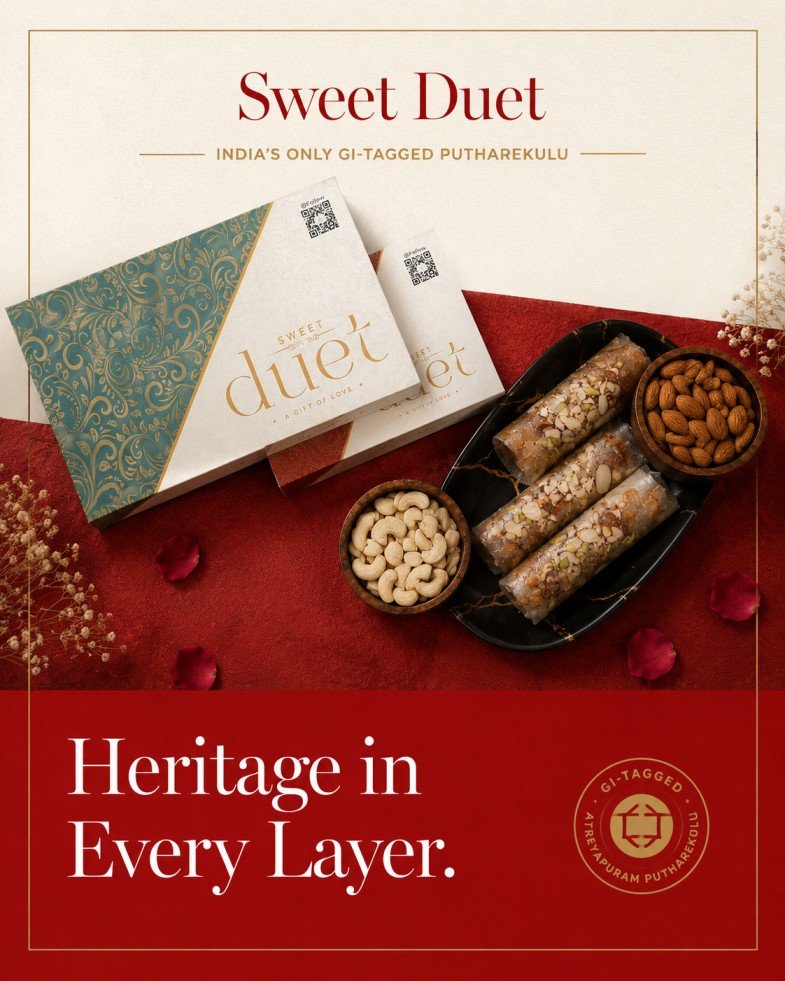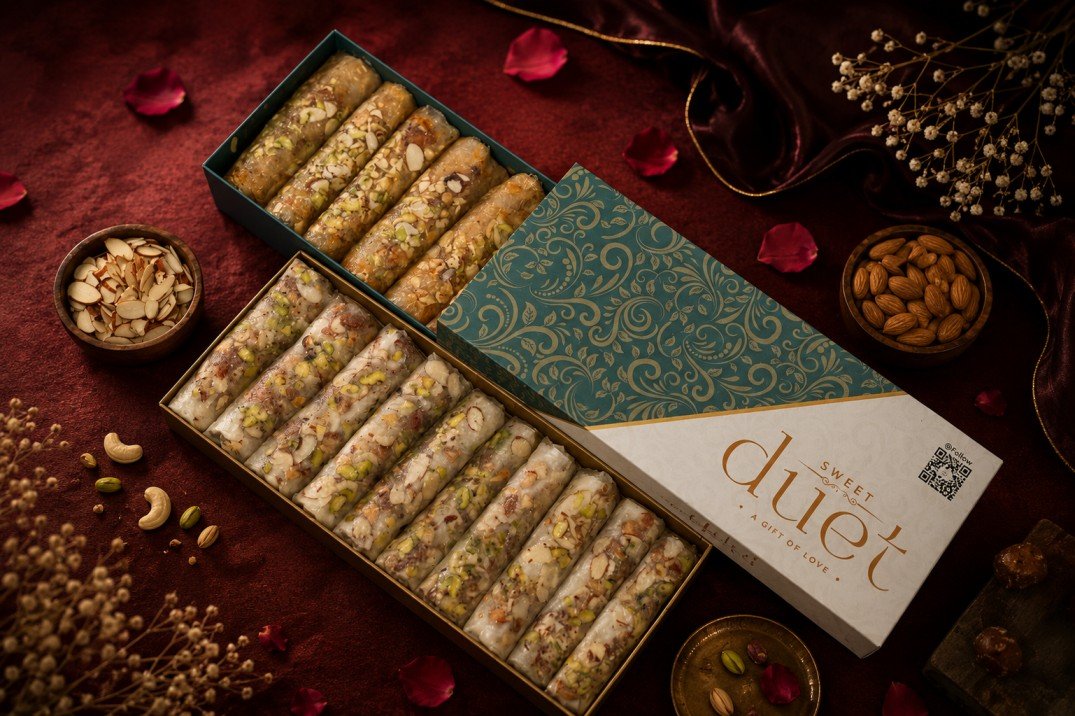
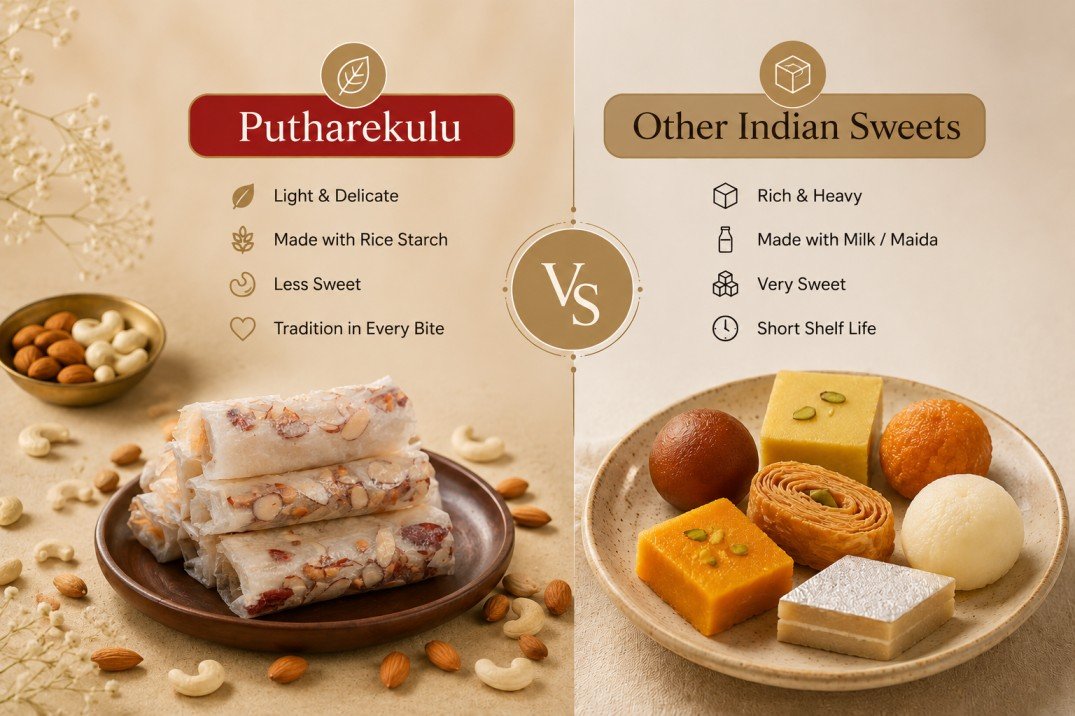
Putharekulu vs Other Indian Sweets, Why Nothing Quite Compares
Every festival season in India, the same conversation happens across thousands of households and corporate offices. Which sweets to gift? Kaju Katli again? Another box of assorted mithai? A dry fruit hamper?
These are good sweets. But they are also the sweets that everybody sends, everybody receives, and everybody politely acknowledges before setting aside for guests who may or may not finish them before they go stale.
This is not an argument against Kaju Katli. This is an argument for thinking differently about what a sweet gift is supposed to do.
And that argument is best made by looking at Putharekulu and asking honestly: how does it compare?
What Makes a Sweet Gift Worth Giving?
Before comparing sweets, it helps to ask the right question. The question is not which sweet tastes best. Taste is deeply personal and varies by community, upbringing, and occasion. The more useful question for gifting is:
What does this gift make the recipient feel when they open it?
A gift that creates genuine surprise, curiosity, and conversation does something most gifts do not, it makes the giver memorable. The recipient does not just remember the sweet. They remember who sent it.
With that question in mind here is how Putharekulu compares to the most common Indian sweets in the gifting context.
Putharekulu vs Kaju Katli
Kaju Katli is India’s most popular premium gifting sweet. Diamond-shaped, silver-foiled, made from cashews and sugar it is elegant, universally appreciated, and consistently good.
It is also the sweet that almost every recipient receives multiple times during Diwali.
KAJU KATLI:
Taste: Rich, nutty, melt-in-mouth
Texture: Smooth, dense, consistent
Shelf life: 7–10 days
Gifting familiarity: Very high
Recipient reaction: Expected
Story behind it: Limited
GI protection: No

PUTHAREKULU:
Taste: Light, ghee-rich, clean sweetness
Texture: Paper-thin crispy layers unique
Shelf life: 20 days
Gifting familiarity: Low outside Telugu community
Recipient reaction: Genuine surprise
Story behind it: 300-year GI-tagged heritage
GI protection: Yes  Certificate No. 483
The honest verdict: Kaju Katli wins on universal recognition. Putharekulu wins on memorability. If you want to give someone a sweet they will genuinely remember and remember you for Putharekulu is the answer. If you want to give something everyone already knows and expects, Kaju Katli is perfectly fine.
For gifting to recipients who have never tasted Putharekulu which is most of corporate India outside the Telugu community the novelty factor alone makes it the more impactful choice.
Putharekulu vs Ladoo
Ladoo is perhaps India’s most culturally embedded sweet. Every community has its version Motichoor, Besan, Boondi, Coconut, Rava. It is auspicious, widely loved, and deeply tied to celebrations and religious rituals.
LADOO:
Taste: Sweet, ghee-rich, varies by type
Texture: Soft, round, crumbly
Shelf life: 7–15 days (varies by type)
Gifting familiarity: Extremely high
Recipient reaction: Comfortable, familiar
Story behind it: Cultural, regional
GI protection: Some regional variants

PUTHAREKULU:
Taste: Light, ghee-rich, clean sweetness
Texture: Paper-thin crispy layers
Shelf life: 20 days
Gifting familiarity: Moderate to low
Recipient reaction: Curiosity and surprise
Story behind it: 300-year specific origin story
GI protection: Yes
The honest verdict: Ladoo and Putharekulu serve different gifting moments. Ladoo is the right choice when cultural resonance and tradition are most important religious occasions, prasad distribution, family gatherings with elders who value familiar taste. Putharekulu is the right choice when you want the gift to stand out corporate occasions, urban gifting, non-Telugu recipients, premium moments where the story behind the sweet matters as much as the taste.
They are not competitors. They serve different intentions.
Putharekulu vs Mysore Pak
Mysore Pak is a South Indian classic ghee-heavy, dense, and unmistakably rich. Made from besan, ghee, and sugar, it carries the royal heritage of the Mysore Palace where it was allegedly first created for the Wadiyar king.
MYSORE PAK:
Taste: Intensely rich, ghee-forward, dense
Texture: Crumbly, melt-in-mouth
Shelf life: 15–20 days
Gifting familiarity: High in South India
Recipient reaction: Comfortable for South Indians
Story behind it: Royal Mysore origin
GI protection: No (Dharwad Peda has GI,
               Mysore Pak does not)

PUTHAREKULU:
Taste: Light, balanced, ghee-present but subtle
Texture: Paper-thin crispy completely unique
Shelf life: 20 days
Gifting familiarity: Moderate in South India
Recipient reaction: Discovery and delight
Story behind it: 300-year village heritage, GI tag
GI protection: Yes
The honest verdict: Mysore Pak is the heavier, richer choice appropriate for occasions where indulgence is the point. Putharekulu is the lighter, more delicate choice appropriate for occasions where the eating experience should feel refined rather than heavy. For pan-India gifting to diverse audiences, Putharekulu’s lighter profile makes it more broadly appealing than Mysore Pak’s intensity.
Putharekulu vs Dry Fruit Boxes
Premium dry fruit boxes almonds, cashews, pistachios, dates, figs in elegant packaging have become a staple of corporate Diwali gifting. They are health-conscious, universally appreciated, and carry a sense of premium value.
DRY FRUIT BOX:
Taste: Natural, nutty, no added sweetness
Texture: Varies by contents
Shelf life: 3–6 months
Gifting familiarity: Very high corporate standard
Recipient reaction: Appreciated but expected
Story behind it: None
GI protection: No

PUTHAREKULU:
Taste: Light, ghee-rich, sweetened naturally
Texture: Paper-thin crispy layers unique
Shelf life: 20 days
Gifting familiarity: Low in corporate context
Recipient reaction: Genuine curiosity
Story behind it: 300-year GI-tagged heritage
GI protection: Yes
The honest verdict: Dry fruit boxes win on shelf life and health positioning. Putharekulu wins on story, experience, and memorability. The most impactful corporate gifts are not the ones that last longest they are the ones that get talked about. A premium dry fruit box is something people acknowledge. A box of GI-tagged Atreyapuram Putharekulu is something people tell their family about that evening.
For Diwali corporate gifting in particular where the goal is to stand out among the dozens of boxes a decision-maker receives Putharekulu’s differentiation is a strategic advantage that dry fruit boxes cannot offer.
Putharekulu vs Soan Papdi
Soan Papdi has become the subject of many gifting jokes in India the sweet that gets passed from household to household during Diwali because nobody is quite sure what to do with it. It is flaky, light, and perfectly fine but it has developed a reputation as the default gift when no thought has gone into the selection.
We mention it only to make one point clearly: Putharekulu is the opposite of a default gift.
It requires you to know it exists. To seek it out specifically. To understand that it comes from one village in Andhra Pradesh with a Government of India GI tag. The moment you send someone Putharekulu, the gift itself communicates that you chose it deliberately and that deliberate choice is what makes any gift feel meaningful.
Putharekulu Offers That No Other Indian Sweet Does
After comparing across categories, one thing becomes clear. Putharekulu occupies a position in Indian sweets that no other sweet shares simultaneously:
✅ Government of India GI tag
    Geographic exclusivity verified by law

✅ Paper-thin rice starch technique
   Unique preparation method found
     nowhere else in Indian sweets

✅ 300-year continuous heritage
   From a specific village with
     documented artisan tradition

✅ Zero artificial preservatives
   Clean label in an industry
     where additives are common

✅ Women artisan production
   Every piece made by skilled women
     of Atreyapuram whose livelihoods
     depend on this craft

✅ Premium gifting positioning
   Luxury packaging designed for
     the moment of receiving
No other Indian sweet holds all six of these simultaneously. Many hold one or two. Putharekulu holds all six which is why it creates a gifting experience that genuinely cannot be replicated by sending any other sweet.
What We Have Noticed , Sweet Duet’s Honest Observations on Indian Sweets
Running Sweet Duet has given Shahanaz an unusual vantage point someone who thinks about Indian sweets not as a casual consumer but as someone who has spent years understanding exactly what makes Putharekulu different from everything else on the market. Some of what she has noticed is worth sharing directly, because it does not appear in any product description or marketing material anywhere.
On sweetness and ingredients:
The most common thing Shahanaz notices when eating mainstream Indian mithai Kaju Katli, Ladoo, most commercial barfi is that they taste primarily of sugar. Not cashews, not ghee, not the specific ingredient that supposedly defines them but sugar above everything else. The other flavours are present, but they are carrying the weight of a large sugar load.
Putharekulu does not work this way. The sweetness is present from jaggery or sugar but it sits underneath the ghee and the dry fruit flavours, not on top of them. The first thing you taste in Putharekulu is the ghee. Then the dry fruit. The sweetness is the last note, not the first. This is an unusual flavour architecture for an Indian sweet and it is one of the main reasons people who are not typically fond of very sweet things find themselves enjoying Putharekulu when they expected not to.
On the flour feeling:
There is a texture quality that Shahanaz has noticed in many commercial Indian sweets that she calls the “flour feeling” a density and heaviness that comes from besan, khoya, or maida-based sweets. You eat a few pieces and you feel it a heaviness in the stomach that signals you have had enough.
Putharekulu does not do this. The rice starch sheets are paper-thin and almost weightless. The ghee is present but not heavy. You can eat Putharekulu and not feel the accumulated weight that other sweets create after a few pieces. This is not because it is a health food it is simply because the base ingredient is rice starch, not dense flour or milk solids. The lightness is structural, not nutritional.
On freshness and what other sweet brands do that Putharekulu cannot:
This is the observation that surprised us most when we first understood the mainstream Indian sweet industry and it changed how we think about what we sell.
In most commercial mithai shops, unsold inventory does not get wasted. Ladoo that did not sell today gets broken down, mixed back into the base dough, and reformed into new Ladoo tomorrow. Barfi that was not purchased gets crushed and incorporated into the next batch. This is standard practice it keeps wastage low and margins healthy.
With Putharekulu, this is impossible.
The paper-thin rice starch sheets once made, once filled, once rolled cannot be unrolled, broken down, and reformed. There is no recombination process. A piece of Putharekulu that is not sold cannot become a new piece of Putharekulu. It can only be discarded.
This single structural fact has a profound implication for freshness. Every piece of Putharekulu in existence was made specifically as a new piece. It has never been recycled into a previous batch. It carries no hidden age from prior production cycles that did not sell.
At Sweet Duet, we make every order fresh after it is placed which takes this structural advantage even further. We have no inventory to recycle even if we wanted to. Your order is made for you, after you place it, from ingredients that have never been part of a previous batch.
When Shahanaz thinks about what genuinely distinguishes Putharekulu from every other Indian sweet it is not just the GI tag or the heritage or the texture. It is this: Putharekulu is structurally incapable of being anything other than fresh. And that is a quality no amount of marketing can manufacture in a sweet that can be reformed and recycled.
The “Made In Front of You” Observation
Add this short paragraph at the end of the section above:
One more thing worth noting. Putharekulu can be made in front of a customer and handed over within minutes fresh, warm, just completed. The entire production process from rice starch sheet to finished rolled piece is visible, fast, and requires no baking, no cooling, no setting time. You can watch your Putharekulu being made and eat it moments later.
Try doing that with Kaju Katli which requires cashew paste to be cooked to a precise consistency, cooled, rolled, and set before it can be cut and served. Or with Ladoo which requires roasting, binding, and shaping time. Most Indian sweets require processes that cannot be rushed or made visible in real time.
Putharekulu is the rare Indian sweet where complete transparency in production is not just possible it is something artisans in Atreyapuram do every day, in open air, for anyone who visits the village to see.
When Should You Choose Something Else?
This comparison would not be honest without acknowledging when Putharekulu is not the right choice.
Choose Kaju Katli or Ladoo when: The recipient is elderly, deeply traditional, and finds comfort in familiar sweets they have eaten all their life. For some people particularly older generations in non-Telugu communities an unfamiliar sweet, however extraordinary, may not land as intended. Know your recipient.
Choose a dry fruit box when: The recipient is health-conscious to the degree that any sweet is unwelcome. A gifting decision made against the recipient’s preferences is not a good one regardless of how extraordinary the product is.
Choose Putharekulu when: You want the gift to create a genuine reaction. When the recipient is open to discovering something new. When you are gifting to corporate contacts, urban professionals, or Telugu community members who will immediately understand the significance. When you want to be remembered not just as someone who sent a gift but as someone who sent something worth talking about.
Closing paragraph:
Indian sweets are among the most culturally rich and emotionally resonant gifts in the world. Every sweet carries a story, a region, a memory. The question is never really which sweet is best the question is which sweet is right for this moment, this recipient, this intention.
Putharekulu does not compete with Kaju Katli or Ladoo or Mysore Pak. It occupies its own space entirely a GI-tagged heritage sweet from one village in Andhra Pradesh, with a 300-year story, made by women artisans using a technique that cannot be replicated anywhere else on earth.
That is not a comparison. That is a category.
Frequently ashok Questions, Putharekulu vs Indian Sweets
Q1: How is Putharekulu different from other Indian sweets?
Putharekulu is made from paper-thin rice starch sheets a technique unique to Atreyapuram village that no other Indian sweet uses. It carries a Government of India GI tag meaning it can only be authentically made in one specific village. Unlike most Indian sweets which use milk solids, flour, or syrup as base ingredients, Putharekulu uses only rice starch, pure ghee, and natural sweetener making it inherently lighter and less cloying than most traditional mithai.
Q2: Is Putharekulu better than Kaju Katli for gifting?
For gifting, Putharekulu has one significant advantage over Kaju Katli memorability. Kaju Katli is India’s most common premium gifting sweet most recipients receive multiple boxes during Diwali. Putharekulu, being a GI-tagged Andhra heritage sweet with a 300-year history and unique paper-thin texture, is something most recipients outside the Telugu community have never encountered. The gift that creates genuine surprise is almost always more memorable than the gift everyone expects.
Q3: Which Indian sweet is best for corporate gifting?
For corporate gifting where the goal is to make a genuine impression, Putharekulu consistently outperforms standard sweet boxes. The GI-tagged heritage story, artisan production by women of Atreyapuram, luxury packaging, and genuine rarity make it a conversation starter rather than a checkbox gift. Standard corporate sweet boxes Kaju Katli, assorted mithai, dry fruit boxes are expected. Putharekulu is unexpected. In corporate gifting, unexpected creates impact.
Q4: What makes Putharekulu special compared to regular mithai?
Several things distinguish Putharekulu from regular mithai. The paper-thin rice starch sheets require years to master and cannot be replicated outside Atreyapuram. The GI tag confirms its geographic exclusivity. Pure desi ghee without artificial additives makes it cleaner than most commercial mithai. And the 300-year heritage story carried by every piece gives it cultural depth that mass-produced sweets cannot replicate.
Q5: Can non-Telugu people enjoy Putharekulu?
Absolutely. Putharekulu’s appeal is universal the delicate texture, pure ghee richness, and clean sweetness translate across all palates and communities. The Sugar variant is particularly well-suited for non-Telugu recipients as its lighter sweetness is more familiar. Sweet Duet’s Putharekulu is regularly ordered for corporate gifting across India to recipients from all backgrounds and consistently receives enthusiastic responses from people tasting it for the first time.
Experience the Difference Yourself
Sweet Duet’s GI-tagged Atreyapuram Putharekulu handcrafted fresh per order, zero preservatives, luxury gifting packaging. Pan-India delivery.